
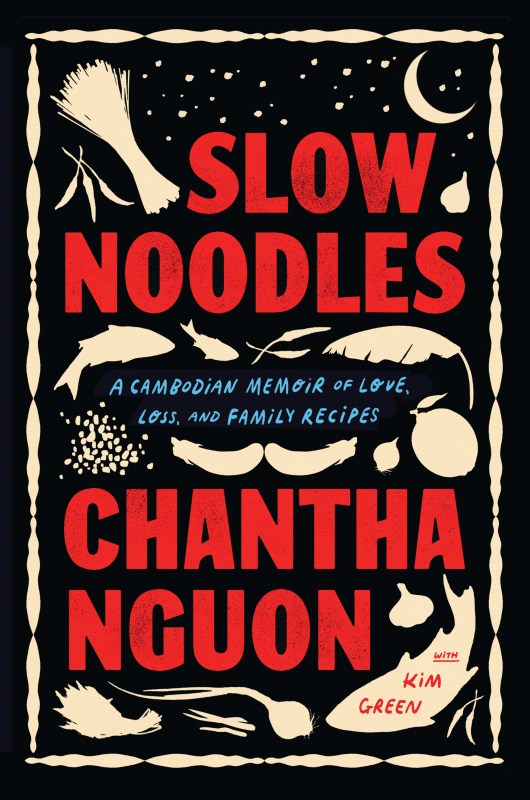
Plot Synopsis –A haunting and beautiful memoir from a Cambodian refugee who lost her country and her family during Pol Pot’s genocide in the 1970s but who finds hope by reclaiming the recipes she tasted in her mother’s kitchen.
Publication Date – Feb. 20, 2024
Rating – 5 out of 5 Stars ⭐
Support the Author’s Nonprofit – Stung Treng Women’s Development Center
Content Warning – This book is a memoir that covers the vicious Cambodian Civil War and the Khmer Rouge as well as the author’s life in various relocation or refugee camps. There are scenes of violence, mention of rape, starvation, malnourished children, and other atrocities of war and survival. There are also mentions of suicide.
Review – Every year I read a handful of nonfiction books and Slow Noodles is probably one of my favorite nonfiction books I’ve ever read. Chantha recounts the joy of her childhood and the horror of losing everything and everyone. Only once she becomes “white hands” (truly in poverty) does she begin to build back up. This book not only educated me on the history of Cambodia, but also the refugee experience. It’s not a quick journey to a satisfying ending, this memoir takes us through decades of loss and survival.
How do we experience our culture? Chantha starts her memoir just before she’s nine years old. In that happy bubble of her childhood, her best memories are in the kitchen with her sister and mother. The beauty of this memoir is the interwoven recipes. Chantha revives her culture through food. She has no photos, no written history, but she does have her puppy nose and the remembrance of her mother’s dishes. That’s how she rebuilds and finds joy. Even at her lowest, her family always found joy in food when they could.
When Pol Pot comes to power and promises to purify Cambodia, Chantha’s family starts the exodus to Saigon. Chantha is half Cambodian and half Vietnamese; her mother knew that they weren’t safe, and so they ran. In Saigon, Chantha lives in a small house with her siblings, though slowly her siblings leave with the exception of her older sister. Through these times of fear and poverty, Chantha still finds joy in her friendships and in food. Even as she loses family and friends, as she flees to new homes and has to keep starting over.
There are times when reading I grimaced and times when I almost cheered. Chantha’s story is heartbreaking, but all too familiar. Refugees the world over have similar stories of loss and redemption. Some only have stories of loss. Embedded in the story is also female empowerment. Even when Chantha is at her lowest, she still looks for small ways to lift up others. When trying to escape Cambodia the second time with Chen, she cooks for a brothel, but it’s not just cooking. She also tries to help by providing medical care to the women who work there. Later when her and Chen start their own nonprofit (link above), the focus is female empowerment through education.
This book is beautiful and haunting. Thank you, Chantha, for giving us your history.
Thanks to Algonquin Books for the ARC.

 Kim Writes Stuff
Leave a comment